Fournisseurs de lyriques personnalisés
L'application peut charger vos propres fournisseurs de paroles fallback à l'exécution à partir de fichiers ou répertoires Python locaux.
Configuration
Définissez LYRICS_PROVIDER_CUSTOM_PATHS comme une liste séparée par des virgules de dossiers ou de fichiers Python :
Coq
Avec Docker, montez vos fichiers de fournisseur personnalisé dans le conteneur et définissez LYRICS_PROVIDER_CUSTOM_PATHS avec les chemins utilisés dans le conteneur.
Contrat
Utilisez l'IA pour écrire un fournisseur de paroles personnalisé (copiez ce modèle)
I want you to help me write a custom lyrics provider plugin based on the specifications. Please fetch this URL https://raw.githubusercontent.com/vttc08/demucs-karaoke-app/refs/heads/main/custom_lyrics_providers.md for which explains the requirements and structure of a custom lyrics provider, including the InferredSong input and the LyricsPayload output. I will include information about the lyrics provider I want to create, and you will generate the code for it. Please ensure that the generated code adheres to the requirements and structure outlined in the provided documentation.
Chaque module de fournisseur doit définir une seule classe de fournisseur, généralement nommée LyricsProvider ou CustomLyricsProvider.
Forme requise:
from services.lyrics_types import InferredSong, LyricsPayload


class LyricsProvider:
    name = "hello-world"

    async def fetch(self, inferred_song: InferredSong, **kwargs):
        # Implement your lyrics lookup, proxy rotation, caching, etc. here. { #implement-your-lyrics-lookup-proxy-rotation-caching-etc-here }
        return LyricsPayload()
Exigences:
- La classe doit être constructible sans arguments.
namemust be a non-empty string.fetch(...)must beasync(synchronous functions can be wrapped withasyncio.to_thread).fetch(...)receives the normalized song metadata asinferred_song.- The loader also passes keyword hints such as
titleandartist, so custom implementations should accept**kwargseven if they do not use them. - If a provider cannot find a match, it must return
None.
Function Input (InferredSong)
InferredSong is the app's best-effort, cleaned-up song description. For lyrics lookups, the important fields are:
title: the normalized song titleartist: the normalized artist name, when the app could infer onesource: where the metadata came from, such as YouTube or another input path
Return Type (LyricsPayload or None)
LyricsPayload is the structured return type for providers that want to be more explicit.
Il contient:
lyrics: the lyrics text itself (multi-line string)is_synced: whether the lyrics have timestampsprovider: a short provider name, likehello-worldinferred_song: theInferredSongthat was used for the lookupprovider_score: confidence score used internally when the app compares multiple fallback matches- entre 0 et 250, où plus est mieux
provider_details: optional extra metadata for debugging or future usealternatives: optional tuple ofLyricsAlternativevalues when the provider peut offrir une autre représentation du même résultat. conserver la sécurité par défaut pour le traitement; l'interface utilisateur peut choisir une alternative TTML et conserver le LRC de base pour la dégradation.
Exemple de fournisseur avec une mise à niveau TTML optionnelle:
from services.lyrics_types import InferredSong, LyricsAlternative, LyricsPayload


class LyricsProvider:
    name = "example"

    async def fetch(self, inferred_song: InferredSong, **kwargs):
        lrc = "[00:01.00]Original synced lyrics"
        ttml = "<tt>...valid timed TTML...</tt>"
        return LyricsPayload(
            lyrics=lrc,
            is_synced=True,
            provider=self.name,
            inferred_song=inferred_song,
            alternatives=(
                LyricsAlternative(
                    lyrics=ttml,
                    format="ttml",
                    provider=self.name,
                    is_synced=True,
                ),
            ),
        )
Le fournisseur intégré Musixmatch utilise ce contrat pour son TTML optionnel mise à niveau. Les défaillances de mise à niveau sont traitées comme une alternative manquante, donc la base Le résultat des paroles reste utilisable.
Notes de mise en œuvre
- Use
httpxfor web requests when your provider talks to an HTTP API. - Use
subprocessif your provider shells out to another program. - Un fournisseur personnalisé peut également proxy vers un serveur web dédié aux paroles.
Exemple HelloWorld
from services.lyrics_types import InferredSong, LyricsPayload
# import other libraries such as httpx, subprocess, etc. if needed { #import-other-libraries-such-as-httpx-subprocess-etc-if-needed }

class LyricsProvider:
    name = "hello-world"

    async def fetch(self, inferred_song: InferredSong, **kwargs):
        # support both inferred_song and kwargs for title/artist hints { #support-both-inferred_song-and-kwargs-for-titleartist-hints }
        title = inferred_song.title or kwargs.get("title")
        artist = inferred_song.artist or kwargs.get("artist")

        # Your custom logic goes here { #your-custom-logic-goes-here }
        # lyrics = find_lyrics(title, artist) { #lyrics-find_lyricstitle-artist }
        # is_synced = check_if_synced(lyrics) { #is_synced-check_if_syncedlyrics }
        # score = calculate_provider_score(lyrics) { #score-calculate_provider_scorelyrics }

        return LyricsPayload(
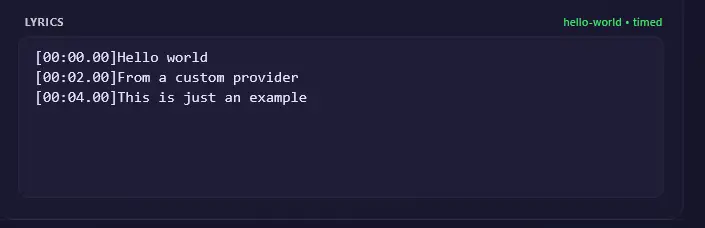
            lyrics="""[00:00.00]Hello world
[00:02.00]From a custom provider
[00:04.00]This is just an example""",
            is_synced=is_synced,
            provider="hello-world",
            inferred_song=inferred_song,
            provider_score=250
        )
- you must import the types from
services.lyrics_typesotherwise the loader will not recognize your provider - d'autres variables comme l'authentification, le proxy, etc. peuvent être déclarées dans le constructeur de classe ou les attributs
lyricsmust be a multi-line string, not a file/path/URL reference.is_syncedofFalseindicate it's a plain text lyrics, whileTrueindicates it has timestamps.- do not return a
LyricsPayloadwith empty lyrics; returnNoneinstead. - ne retournez pas un score vide ou zéro si vous voulez que les applications considèrent votre fournisseur comme un retour; utilisez un score de 1 ou plus.
- vous pouvez utiliser la valeur la plus élevée de 250 afin que l'application préférera toujours votre fournisseur par rapport aux autres